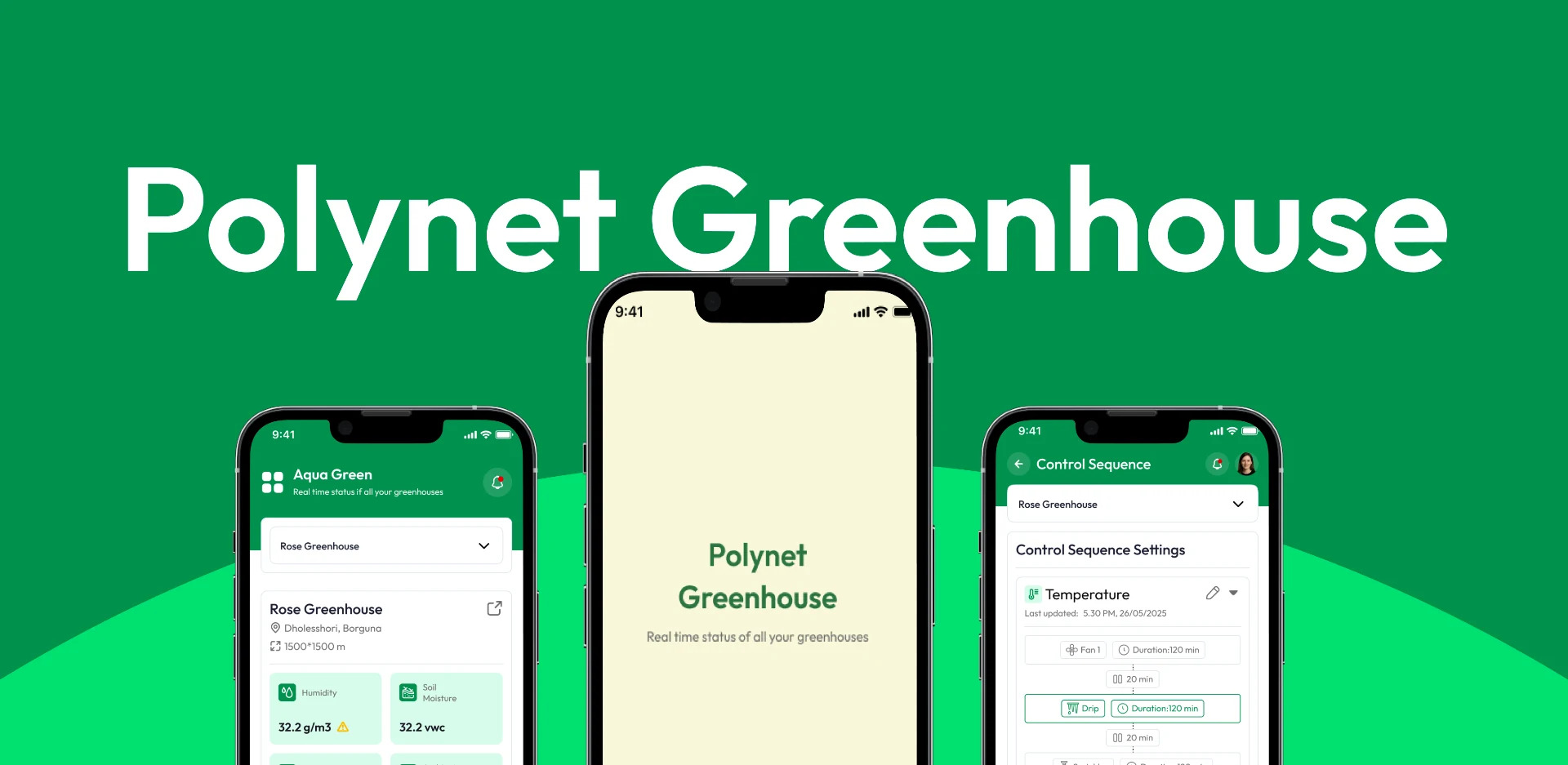
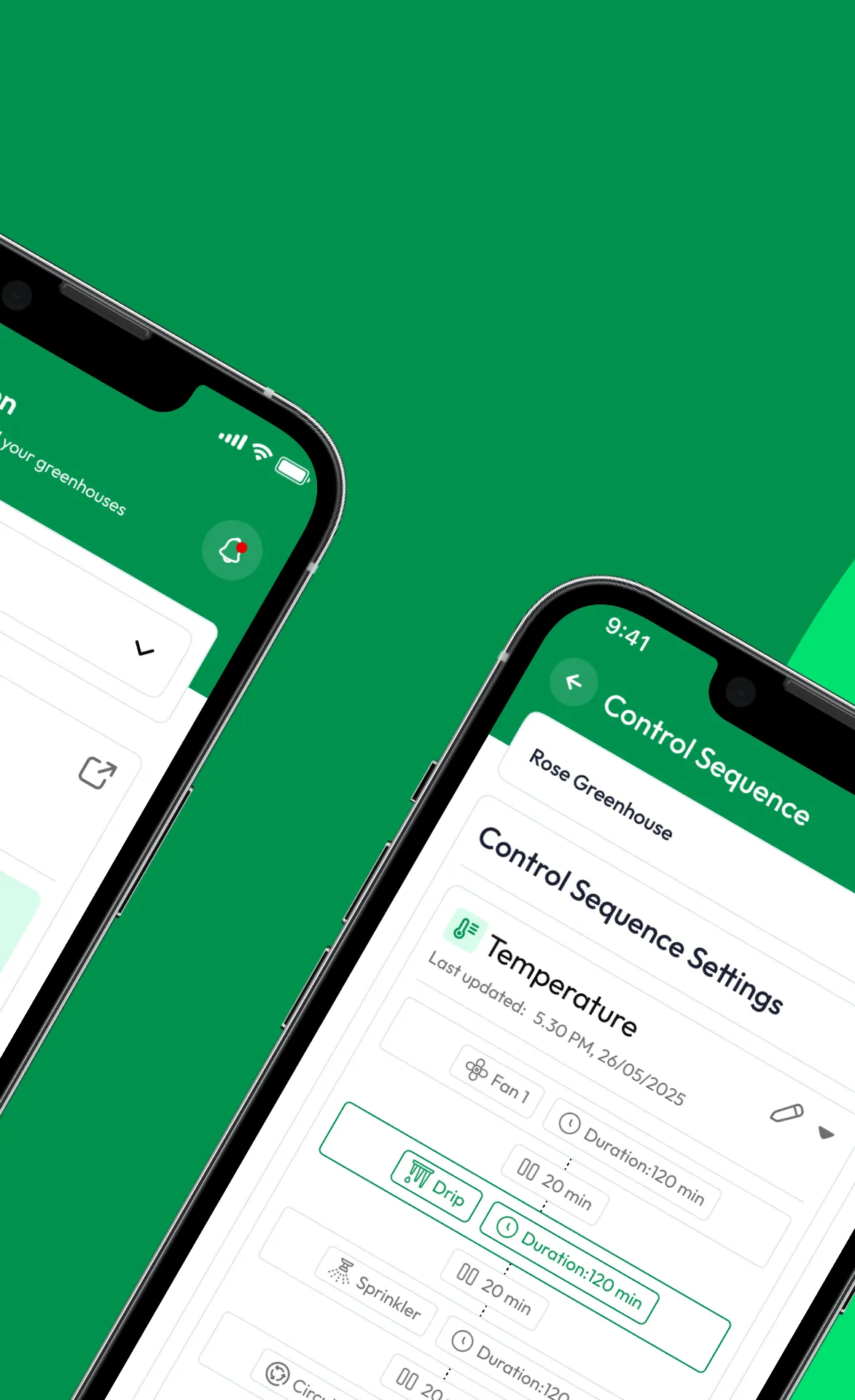
Polynet Greenhouse: Monitor, Control, Automate — hero banner
    Back to Projects
    Agritech / IoT
    SDG 2
    SDG 9
    SDG 13

    Polynet Greenhouse: Monitor, Control, Automate

    Real-time greenhouse environment monitoring and automated control sequencing for polynet greenhouses — optimizing crop growth conditions remotely.

    My Role
    Product Manager & Technical Lead
    Deployment
    100+ Sensors

    Overview

    The Polynet Greenhouse system is an IoT-powered solution for real-time monitoring and automated control of greenhouse environments. It tracks critical parameters like humidity, temperature, soil moisture, and ambient conditions — enabling farmers to remotely manage fans, foggers, drip irrigation, sprinklers, and circulators. With smart control sequencing, operators can automate complex irrigation and ventilation workflows, ensuring optimal growing conditions while reducing manual intervention and resource waste.

    The Problem

    Polynet greenhouses are one of the most effective interventions for climate-resilient agriculture in the region — they extend growing seasons, cut water consumption, and protect crops from erratic rainfall. They are also surprisingly complex to operate. A poorly-ventilated polynet house can spike to over 45°C in under an hour on a bright afternoon, cooking the very crop it was built to protect. Under-irrigation during a dry week wipes out a month's growth overnight.

    The farmers adopting these structures are frequently the same farmers stretched thinnest — smallholders trying to diversify against monsoon risk, often operating two to five houses simultaneously. Asking them to walk every house twice a day to check humidity and soil moisture, and manually toggle foggers and drip lines, is not scalable and it is not what they signed up for.

    The system was designed to replace the walk-and-toggle workflow with a declarative one: the farmer configures the target environmental band and the irrigation protocol once, and the platform sequences the peripherals to hold the greenhouse inside that band. The manual mode remains a first-class option — we deliberately did not remove the lever — but the default is hands-off.

    App Showcase

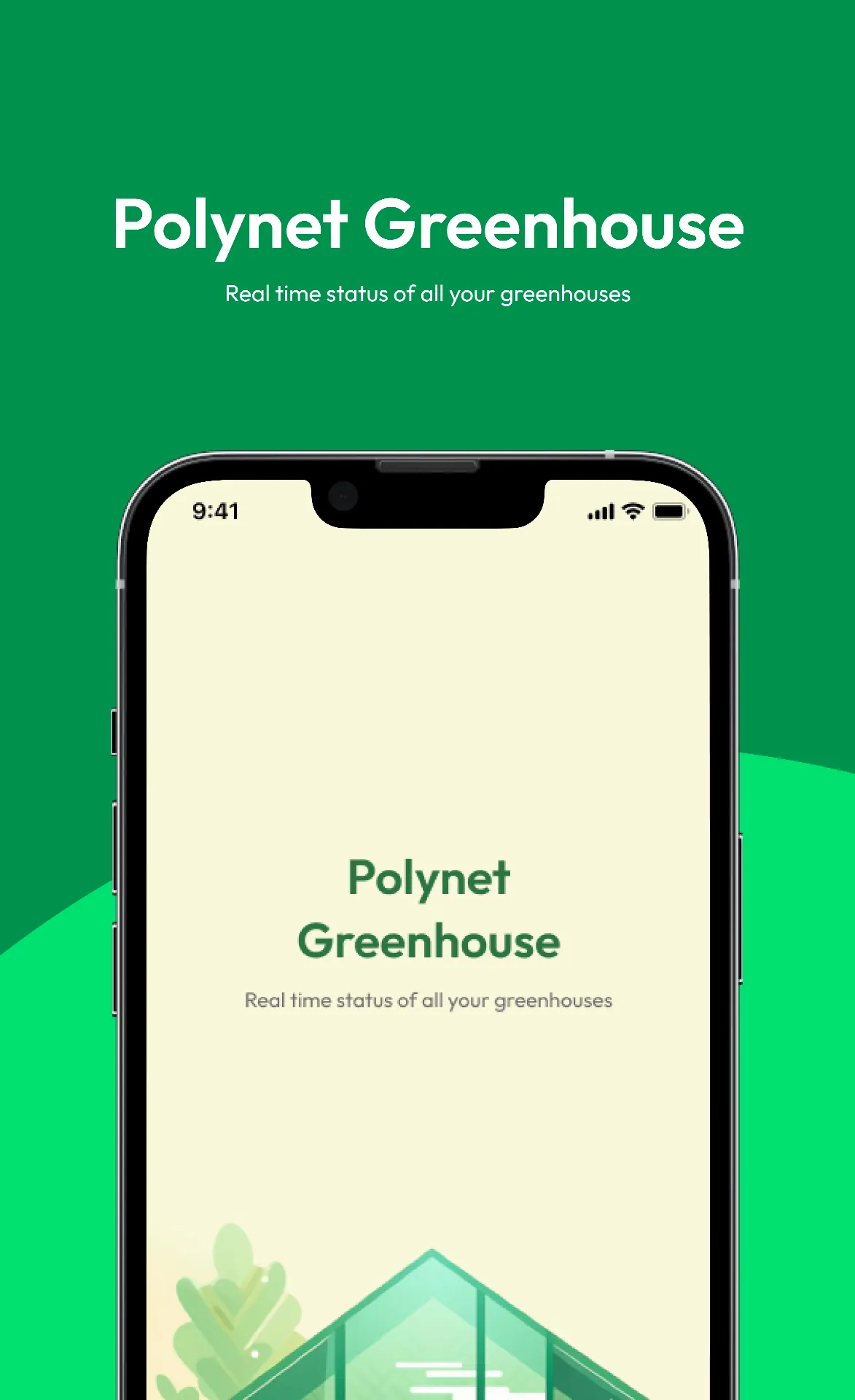
    Greenhouse Splash
    Real time status of all your greenhouses
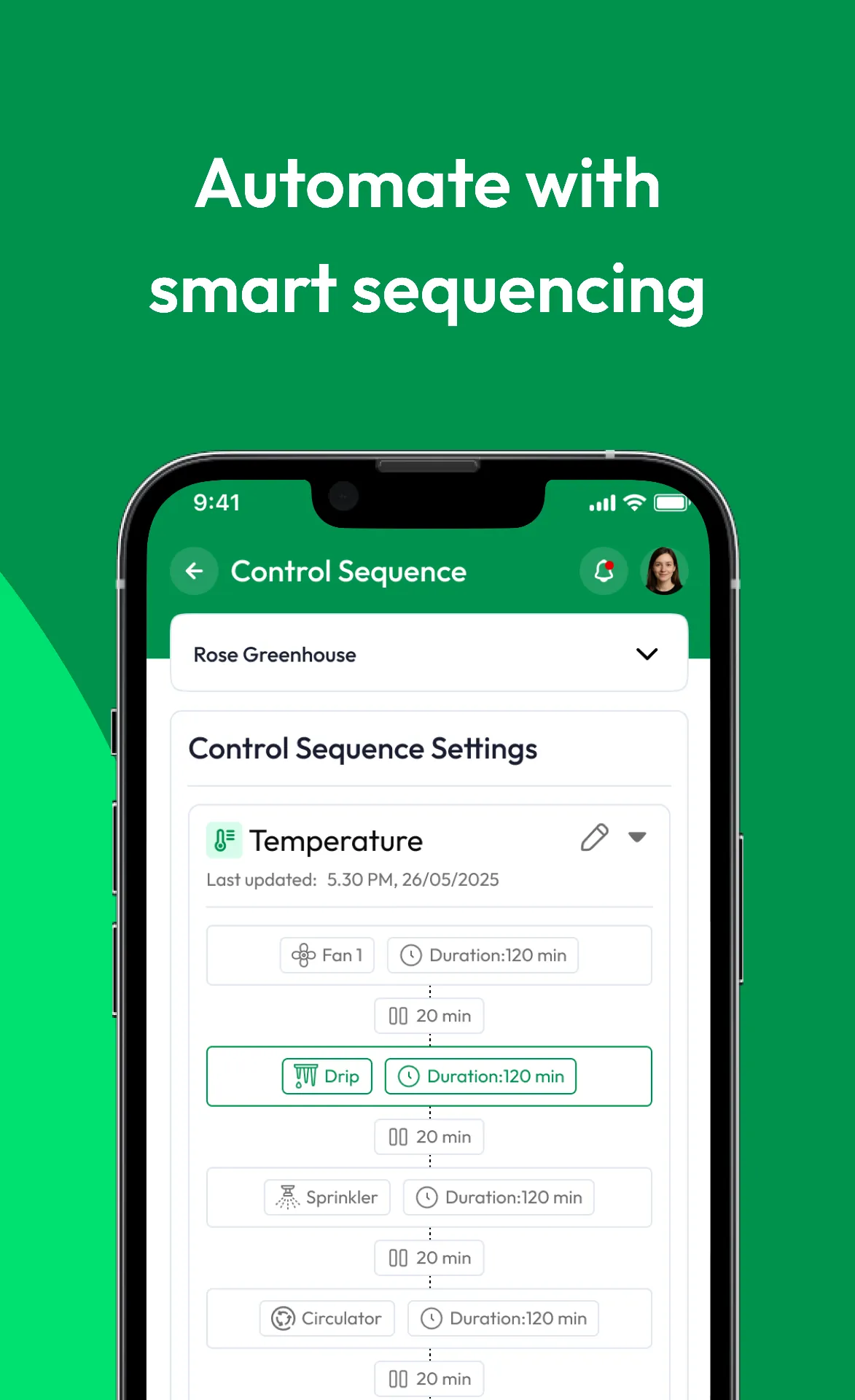
    Smart Sequencing
    Automate with smart sequencing
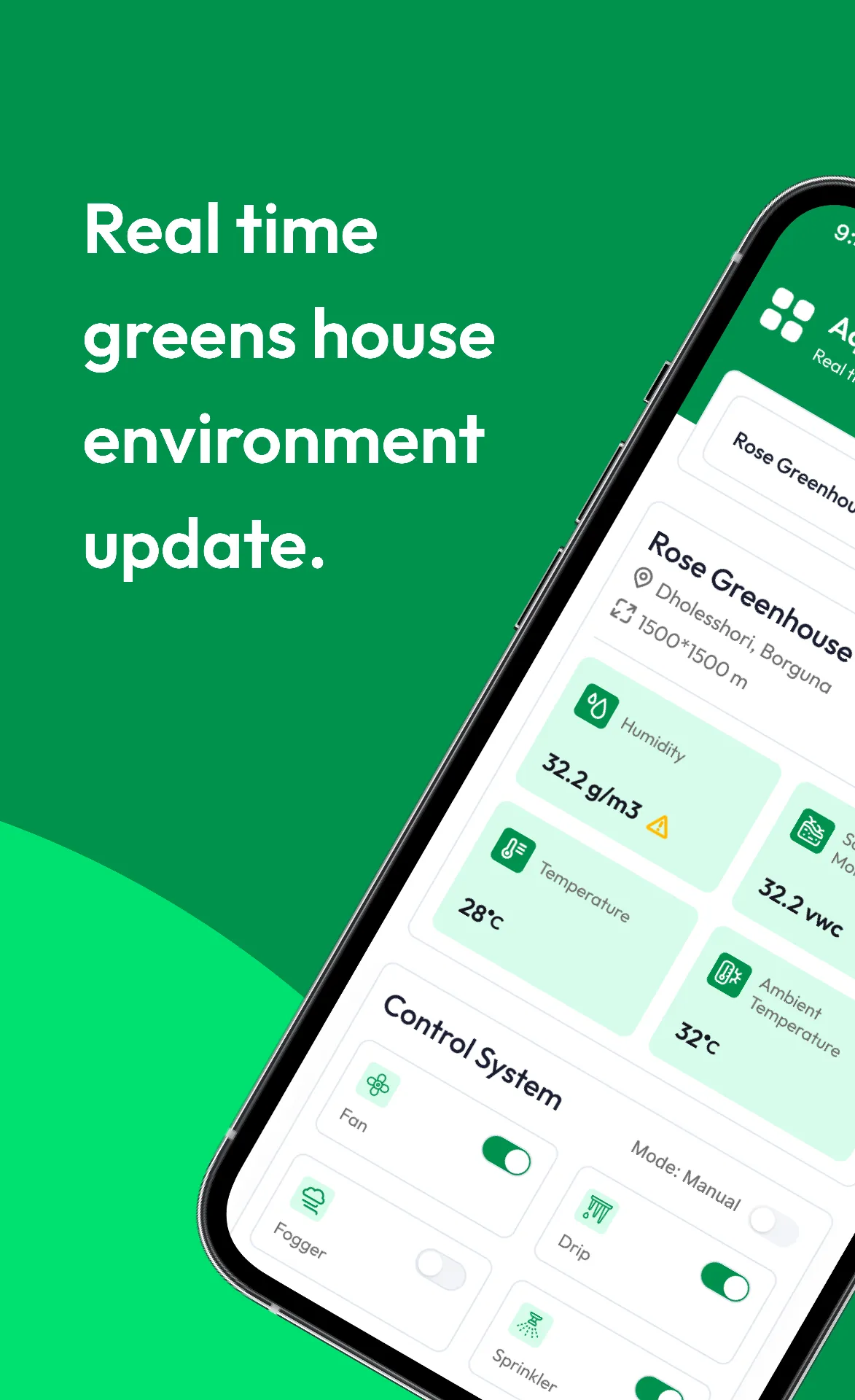
    Environment Monitoring
    Real time greenhouse environment update
    Control Sequence Settings
    Control sequence configuration

    Core Features

    1. 01

      Real-time monitoring of humidity, temperature, soil moisture, and ambient conditions

    2. 02

      Remote control of fans, foggers, drip irrigation, sprinklers, and circulators

    3. 03

      Smart Control Sequence — automate multi-step workflows with duration and interval settings

    4. 04

      Greenhouse selection and management for multi-site operations

    5. 05

      Alert system for abnormal environmental readings

    6. 06

      Manual and automatic mode switching for each peripheral

    Architecture Decisions

    Smart Control Sequences

    The core primitive of the product is the Control Sequence — a small programmable workflow of steps (activate fogger for 90s, pause 5 minutes, activate fan for 3 minutes, observe humidity for 10 minutes, loop). Sequences are composable, scoped to a greenhouse, and have explicit start/stop triggers tied to sensor thresholds. This turned out to be more expressive than a traditional 'schedule' model because it captures the actual operational patterns farmers already follow in their heads.

    Greenhouse profiles as first-class objects

    Different crops, different polynet configurations, and different stages of the growing cycle all demand different environmental bands. We modelled each greenhouse as a profile bundle — species, growth stage, target bands, irrigation protocol, enabled peripherals — and made profiles swappable in a single action. A farmer switching a house from cucumber to capsicum mid-season changes a profile, not twenty individual settings.

    Manual mode as a peer, not a fallback

    We initially treated manual control as a 'fallback' when automation failed. Farmers treated it as the default. So we rebuilt the UI so manual and automatic are peer modes at the peripheral level, switchable with a single tap, and the system remembers which mode each peripheral was in across restarts. Trust came from giving the operator an immediate lever, not from asking them to rely on the platform on faith.

    Hybrid connectivity with offline authority

    Rural connectivity is unreliable in exactly the hours automation is most needed (mid-afternoon heat). Every greenhouse node can execute its active profile entirely from local state for up to 72 hours without cloud. Sensor thresholds trigger peripherals locally; the cloud is used for configuration, observability, and multi-house aggregation but never sits in the critical loop for environmental control.

    Tech Stack

    • IoT
    • React Native
    • MQTT
    • Node.js
    • PostgreSQL
    • Sensor Integration
    • Control Sequencing
    • Real-time Dashboard

    Challenges & Solutions

    Challenge

    Maintaining sensor accuracy in high-humidity greenhouse environments

    Solution

    Deployed humidity-resistant sensors with regular auto-calibration

    Challenge

    Coordinating multiple peripherals in automated sequences

    Solution

    Built a flexible control sequence engine with configurable duration and intervals

    Challenge

    Ensuring reliable connectivity in rural agricultural areas

    Solution

    Implemented hybrid connectivity with offline queue and sync

    Challenge

    Balancing water and energy usage for sustainable farming

    Solution

    Developed resource-optimized scheduling algorithms for water and energy

    Challenge

    Supporting diverse greenhouse configurations and crop types

    Solution

    Created a modular greenhouse profile system supporting diverse configurations

    Results & Impact

    • 30% reduction in water usage

    • Real-time visibility across all greenhouses

    • Automated control sequences reducing manual work by 60%

    • Improved crop yield through optimal environment control

    • Scalable to multiple greenhouse sites

    Lessons Learned

    1. 01

      Composable control sequences beat fixed schedules for agricultural workflows. Farmers already think in terms of 'do X, wait, do Y'; a product that lets them encode that directly is a product they trust.

    2. 02

      Humidity destroys cheap electronics. The first batch of sensor enclosures, rated IP54 on paper, started failing within three months in polynet conditions. IP67 or better is a non-negotiable minimum; the cost delta is recovered in a single avoided field-replacement.

    3. 03

      Per-crop profiles shipped later than they should have. Farmers asked for them on day one and we under-weighted the request because it sounded like a 'later' feature. It is a day-one feature.

    4. 04

      Automation with no visibility into why it fired breeds suspicion. Every sequence run logs the triggering sensor, the threshold, and the action taken, and surfaces those in a readable timeline. Observability built the trust that drove adoption.

    Interested in this project?

    © 2026 Mushfiqur Rahaman · Building for a sustainable future