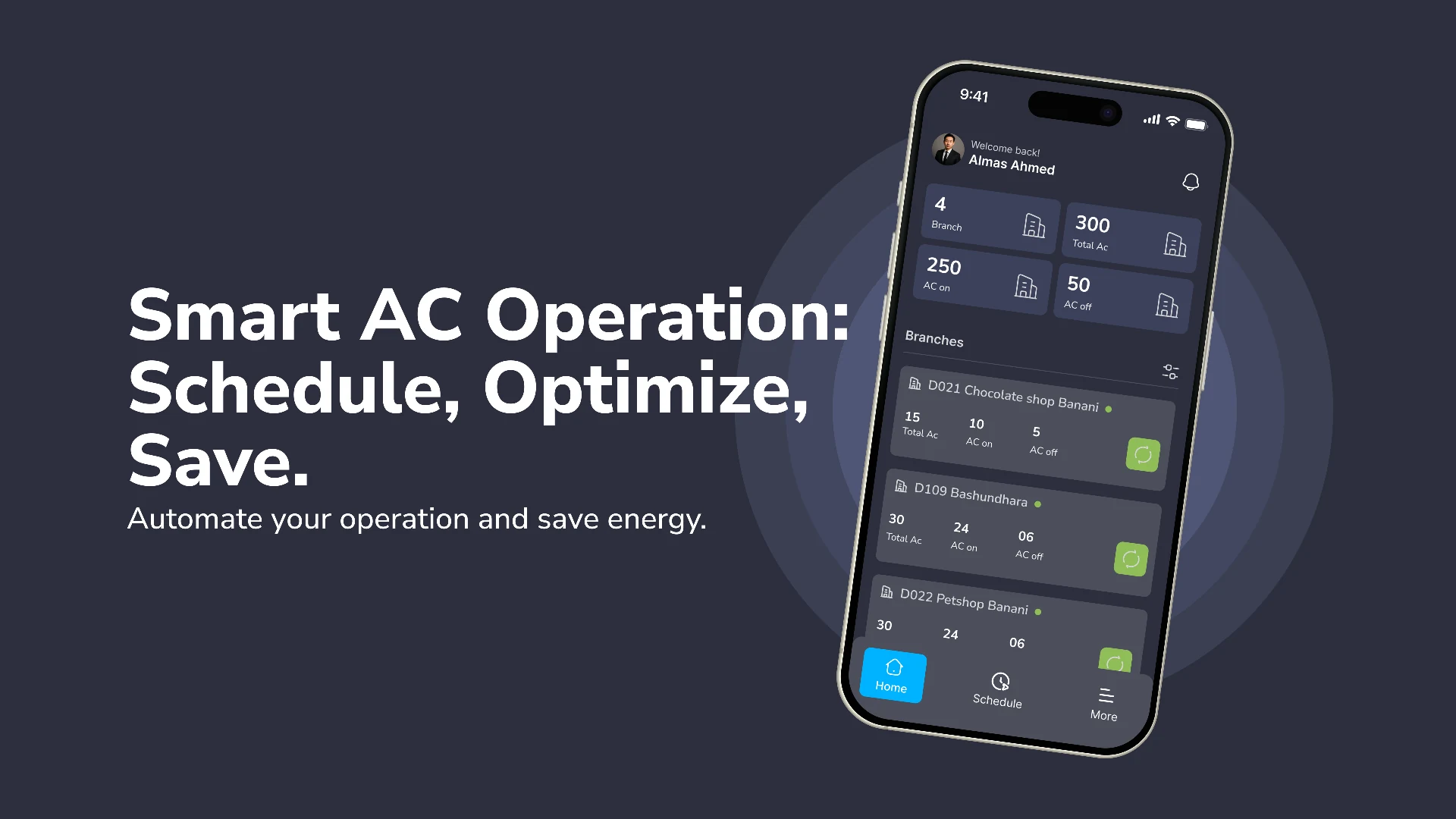
Smart AC Operation: Schedule, Optimize, Save — hero banner
    Back to Projects
    Energy / IoT
    SDG 7
    SDG 9
    SDG 12

    Smart AC Operation: Schedule, Optimize, Save

    Automate your AC operations across multiple branches with smart scheduling, remote control, and energy optimization — all from one app.

    My Role
    Product Manager & Technical Lead
    Deployment
    300+ ACs Managed

    Overview

    The Smart AC Operation platform is an IoT-powered solution for centralized air conditioning management across multiple branches and locations. It enables businesses to remotely monitor, control, and schedule their AC units — reducing energy waste, extending equipment lifespan, and ensuring optimal comfort. With a centralized dashboard, branch-level insights, and intelligent scheduling, facility managers can operate hundreds of AC units efficiently from anywhere.

    The Problem

    Multi-branch retail, banking, and healthcare chains in Bangladesh collectively spend a significant portion of their operating cost on cooling. Air conditioning is typically the single largest controllable line item on the electricity bill, and the single one most often left running after-hours — not because anyone wants to, but because nobody can see it from head office and nobody local is incentivised to check.

    The conventional fixes each have a hard ceiling. BMS (building management systems) are designed for single large buildings, not distributed branch networks, and the cost of retrofitting one into a 14-branch chain is usually prohibitive. Wall-mounted timers work until the first time a branch manager overrides them and forgets to restore the schedule. 'Just train the staff' is not a strategy.

    The Smart AC platform treats the distributed branch network as the primary unit of management and the individual AC as a controllable leaf node — inverting the architecture of a traditional BMS. Facility managers operate at the chain level; branch managers retain local override authority under audit.

    App Showcase

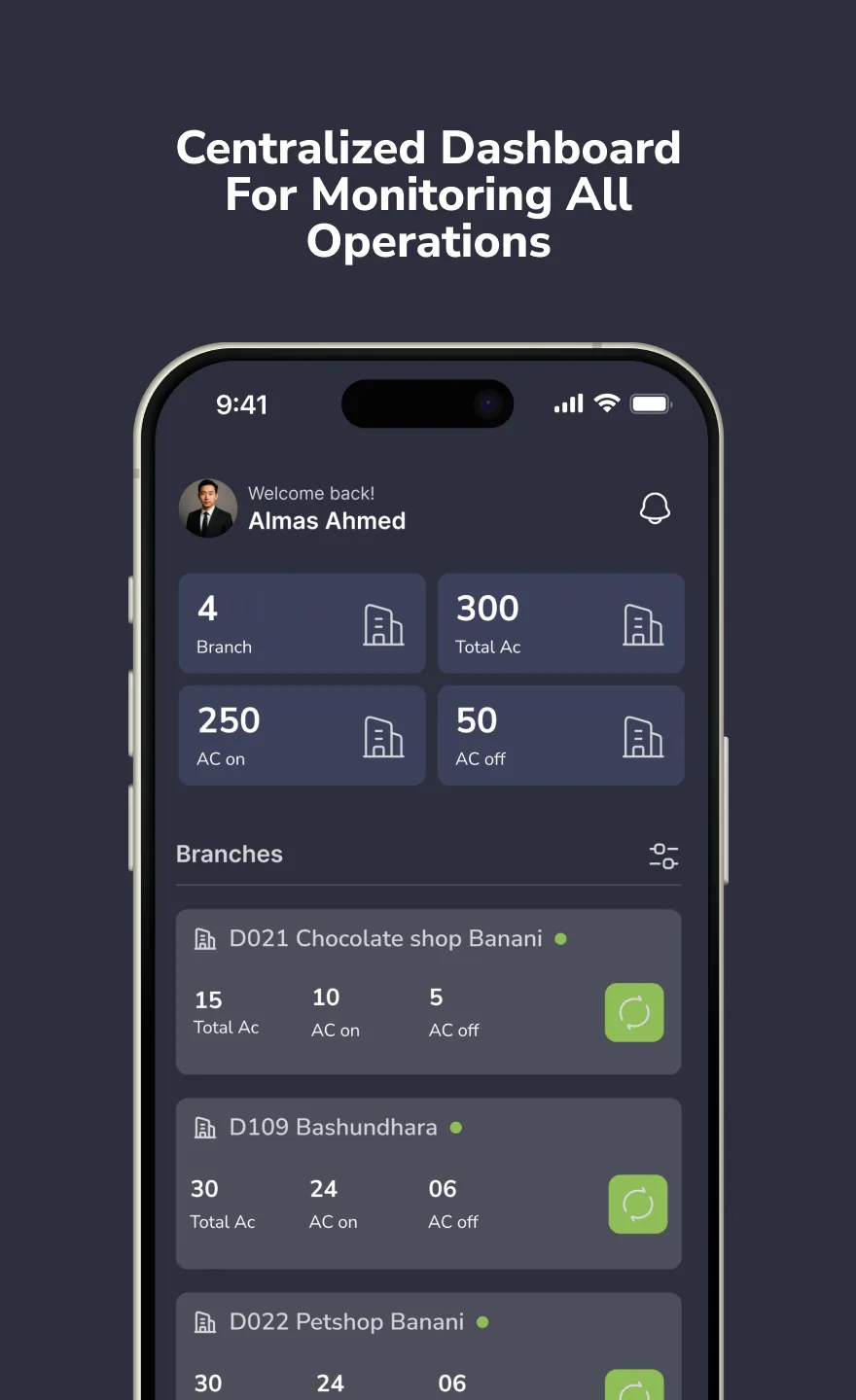
    Centralized Dashboard
    Centralized dashboard for all operations
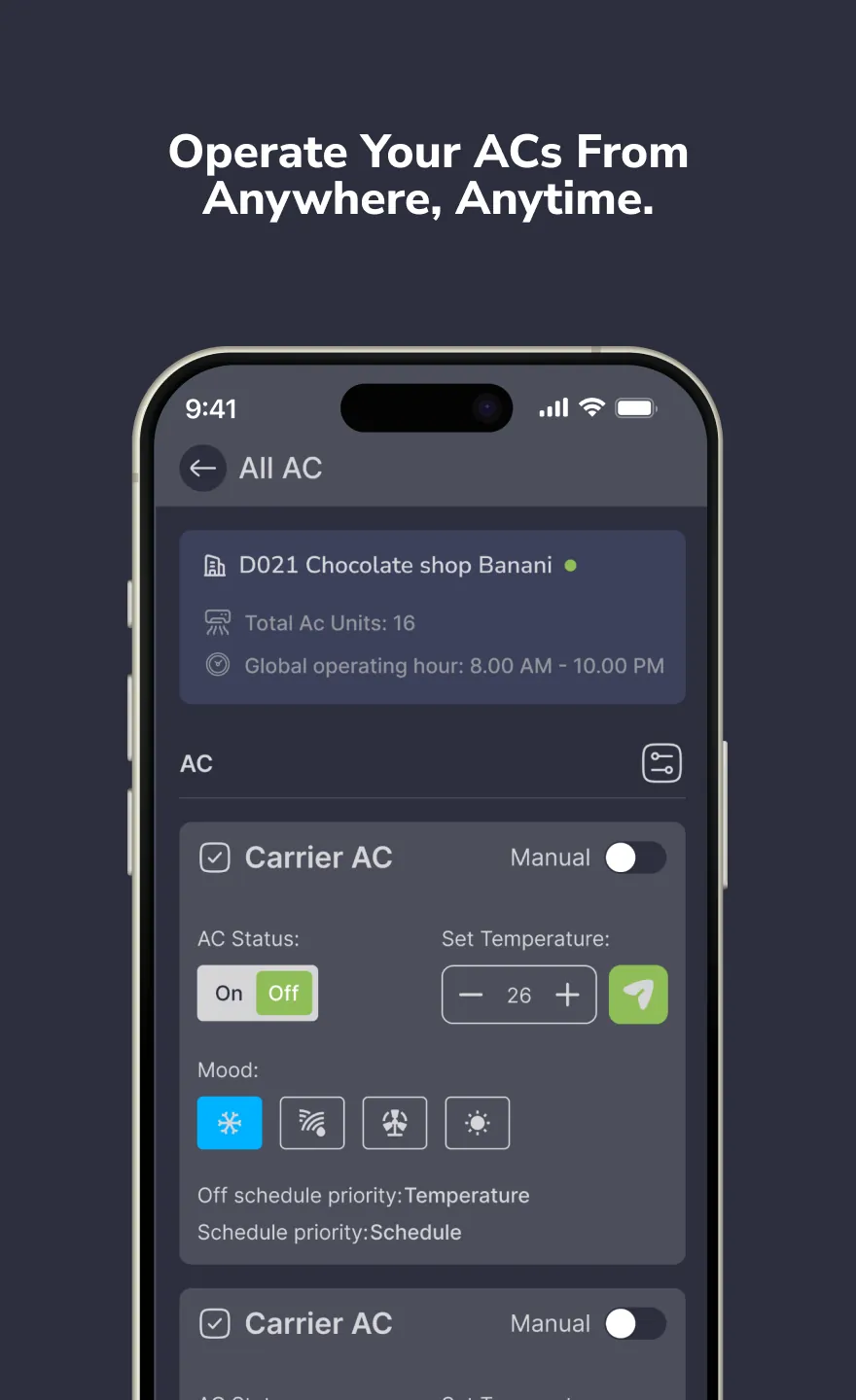
    AC Remote Control
    Operate ACs from anywhere, anytime
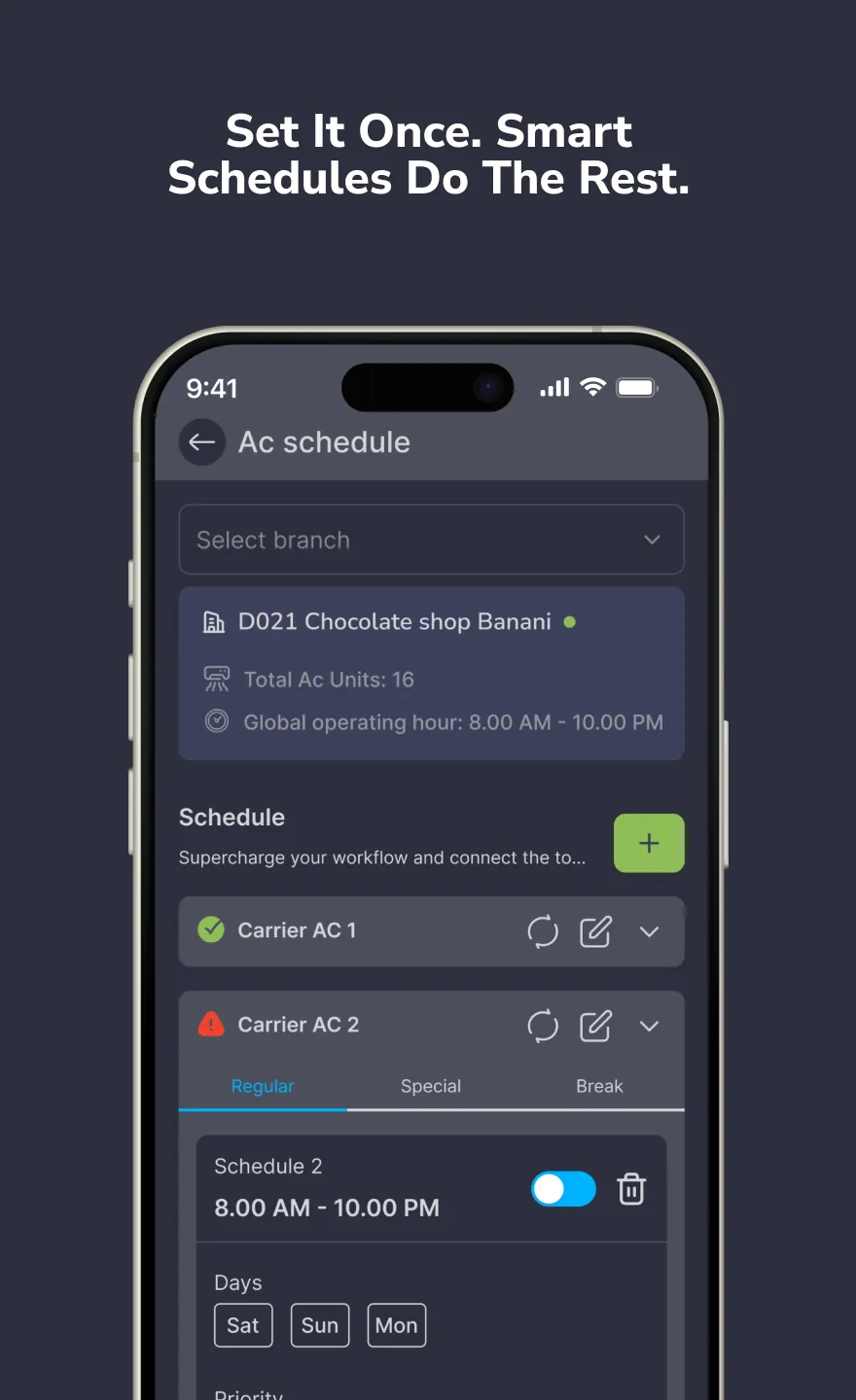
    Smart Scheduling
    Smart schedules do the rest

    Core Features

    1. 01

      Centralized dashboard for monitoring all branches, ACs, and their status

    2. 02

      Remote AC control — turn on/off, set temperature, switch modes from anywhere

    3. 03

      Smart scheduling with Regular, Special, and Break modes per AC unit

    4. 04

      Branch-level management with total AC, on/off counts, and global operating hours

    5. 05

      Manual override toggle for individual AC units when needed

    6. 06

      Priority-based scheduling — temperature vs. schedule priority settings

    Architecture Decisions

    Protocol-agnostic AC adapter

    Real branches have a mix of AC brands, firmware generations, and communication protocols. Instead of limiting deployments to a single supplier, we built a thin adapter layer that normalises on/off, mode, and setpoint semantics across the common protocols (infrared, Wi-Fi proprietary, and Modbus RTU on chiller lines). New branches onboard without any changes in the central platform — only a new adapter profile.

    Three-mode scheduling: Regular, Special, Break

    A single 'weekly schedule' field is not how a multi-branch chain actually operates. Our schedule model is three layered tracks: a Regular baseline (normal operating hours per branch), Special overrides for events and promotions, and a Break mode for planned closures and holidays. Conflicts are resolved with explicit precedence rules that are visible in the UI, so there is no mystery about which rule is currently in force.

    Temperature vs. schedule priority

    Some branches want 'run the AC on schedule no matter what'; others want 'never let the store rise above 26°C regardless of schedule'. We exposed that trade-off as a first-class setting per AC unit rather than hard-coding one policy. The feature sounds minor but drove most of the later-stage energy savings — branches could turn off schedules in off-peak seasons without losing the temperature safety net.

    Auditable manual overrides

    Branch managers retain override authority — we learned early that removing it broke operational trust. What we added was audit: every manual override is logged with the operator, the duration, and the reason, and rolls back automatically to the scheduled policy when the override window expires. Head office gets visibility without having to take the lever away.

    Tech Stack

    • IoT
    • React Native
    • MQTT
    • Node.js
    • PostgreSQL
    • REST API
    • Push Notifications
    • Smart Scheduling

    Challenges & Solutions

    Challenge

    Managing 300+ AC units across geographically distributed branches

    Solution

    Built a hierarchical branch → AC management architecture for scalable control

    Challenge

    Ensuring reliable remote control with minimal latency

    Solution

    Implemented MQTT-based real-time communication with offline queue support

    Challenge

    Balancing automated schedules with manual override requirements

    Solution

    Designed a priority system allowing schedule vs. temperature-based automation

    Challenge

    Reducing energy costs without compromising occupant comfort

    Solution

    Developed smart scheduling with operating hour optimization algorithms

    Challenge

    Handling diverse AC brands and communication protocols

    Solution

    Created a universal adapter layer supporting multiple AC protocols

    Results & Impact

    • 30% reduction in energy costs

    • 300+ ACs managed remotely

    • 14 branches centrally controlled

    • Zero manual intervention needed

    • Extended AC equipment lifespan

    Lessons Learned

    1. 01

      The savings come from behaviour, not automation. The first 15% of energy reduction was just visibility — head office could see that five branches were running AC through the night and simply told them to stop.

    2. 02

      Taking control away from branch managers broke trust faster than we could rebuild it. Local override with audit is the correct design, not head-office-only.

    3. 03

      IR-blaster-based control is convenient but flaky in practice — line-of-sight obstructions and remote-specific codebases caused more false 'offline' alerts than any other source. Wi-Fi or Modbus-capable units are a meaningfully more reliable substrate when available.

    4. 04

      Reporting is the product. Customers renewed on the strength of monthly 'what did I save' reports far more than on any individual feature.

    Interested in this project?

    © 2026 Mushfiqur Rahaman · Building for a sustainable future